
Tenuta Villa San Zeno

Shipping address
37020 MARANO DI VALPOLICELLA, (VR), Italy
Billing address
37012 BUSSOLENGO, (VR) , Italy
Additional information

In 1956 Mr. Riccardo Corradini, with a competence in vineyard cultivation gained from his family of farmers, decided to start the production and commercialization of two of the most important wines of the Verona region: Valpolicella and Amarone.
During the first years, Mr. Riccardo personally dedicated himself to the distribution of wines throughout the province of Verona, specializing in the area of Lake Garda. Shortly after, Mr. Riccardo opened his first winery in Bussolengo, a town located in the foothills of the Valpolicella valley. The family-owned business at this time was also able to expand the sales of its wines in Northern Italy, Austria, Germany and Switzerland.


In 1993 the commercial company Tenuta Villa San Zenowas born, managed no longer solely by its Founder Riccardo but also by me, his son, Mr. Giuseppe Corradini. In just a few years, with passion and dedication, our company has been able to exponentially increase the number of satisfied customers due to our high-quality wines and tailored services.
In 2005 I, Mr. Giuseppe Corradini, took over the role as Owner of Tenuta Villa San Zeno . Since then, in collaboration with my team we have been able to further expand the company’s reach throughout the territory. Following in my father's footsteps I always strive to put the utmost effort in offering our clients an excellent product and punctual service, while holding at our core that which distinguishes our company: passion, dedication and a respect for tradition.
I am confident that with my products you will not only drink wine, but taste emotions...
... a toast to your health!

Soave

The production area of Soave, divided into Classica and DOC, è situata nella fascia collinare ad est di Verona. La zona Classica include solamente due comuni, Soave e Monteforte d’Alpone, mentre in quella DOC fanno parte anche i comuni di San Martino Buon Albergo, Lavagno, Mezzane, Caldiero, Colognola ai Colli, Illasi, Cazzano di Tramigna, San Bonifacio, Roncà, Montecchia di Crosara e S. Giovanni Ilarione.
This particular area can be characterized by its mild climate, where summers tend to be temperate and winters less cold than neighbouring areas. The surrounding hills of this region are mostly composed of tufa soil of volcanic origin and rich in limestone outcrops.
These characteristics allow for the cultivation of vines such as la Garganega, Trebbiano di Soave, Chardonnay and Pinot Bianco , from which Soave Classico DOC, Soave DOC, Soave Superiore DOCG, Recioto di Soave DOCG wines are subsequently produced.
Valpolicella

The Valpolicella area is a set of valleys located north of Verona, which extend from the Lessini Mountains to Lake Garda. The Classica production area includes the municipalities of San Pietro in Cariano, Sant'Ambrogio di Valpolicella, Fumane, Negrar and Marano di Valpolicella. The DOC area consists of 19 municipalities including Verona, Dolcè, Pescantina, San Martino B.A., Lavagno, Mezzane, Illasi, Tregnago, Colognola ai Colli, Grezzana, Cazzano di Tramigna, Cerro Veronese, Montecchia di Crosara, San Mauro di Saline and the 5 municipalities that are part of the Classic area.
The climate of this area is ideal for the cultivation of vines due greatly to the influence of the microclimate of Lake Garda, the cool winds from the Lessini Mountains and the subcontinental climate of the Po Valley. The rich soil in Valpolicella is mainly calcareous, while in some areas it is also clayey and rich in basaltic rocks.
Thanks to the characteristics of the territory, vines such as Corvina Veronese, Corvinone, Molinara, Rondinella, Rossignola and Oseletaare able to be successfully cultivated. These grapes are then used for the production of the wines Corvina Veronese, Valpolicella's Amarone, Valpolicella, Valpolicella Ripasso and Recioto della Valpolicella (all with any specifications Superiore or Riserva, as well as with the references Classico, DOC, DOCG, IGT or Valpantena).
Custoza

The production area of Custoza is a relatively small area situated between the Mincio river, Lake Garda and the city of Verona; it includes the municipalities of Villafranca, Peschiera del Garda, Valeggio sul Mincio, Sona, Sommacampagna, Castelnuovo del Garda, Bussolengo, Pastrengo and Lazise.
This territory has vast morainic hills interspersed with plains of gravel, rich in sediments and characterized by soils of various types. The climate, due to the proximity with Lake Garda, is not excessively cold during winter months with hot summers that are not overly humid.
The climatic and soil characteristics of this area are ideal for the cultivation of vines. The most common grape varieties of the area are Garganega, Riesling, Trebbiano, Trebbianello, Manzoni Bianco, Chardonnay, Malvasia and Bianca Fernanda; these grapes are then used to produce Bianco di Custoza DOC, Bianco di Custoza Superiore DOC, Bianco di Custoza Passito DOC and Bianco di Custoza Spumante DOC.
Bardolino

The production area of Bardolino is located in the morainic amphitheater that goes from the east coast of Lake Garda to the city of Verona. This area is divided into both Classica and DOC. La prima comprende i 6 comuni di Bardolino, Lazise, Garda, Affi, Cavaion Veronese e Costermano; la zona DOC invece, oltre ai comuni della zona Classica, include anche quelli di Bussolengo, Pastrengo, Sommacampagna, Sona, Castelnuovo del Garda, Valeggio sul Mincio, Peschiera del Garda, Rivoli Veronese, Caprino e Torri del Benaco.
The proximity to Lake Garda gives this area a mild climate all year round. The hill-like terrain offers the vines excellent exposure to the sun and a richly versatile soil of clay, sand and gravel.
The climatic and geological characteristics of the area make it ideal for vines such as Corvina Veronese, Rondinella and Molinara. The range of wines produced in this area include Bardolino DOC, Bardolino Classico DOC, Bardolino Chiaretto DOC, Bardolino Chiaretto Classico DOC, Bardolino Chiaretto Spumante DOC, Bardolino Novello DOC and Bardolino Superiore DOCG.
Lugana

This area can be divided into two regions: a flat area with clay soil and an area with steep and low hills where the soil consists of gravel with parts made of sandy clay. The climate of this territory is mild in temperature due in great part to the influence of Lake Garda. Mild temperatures in this region are uniquely constant with no extreme temperature shifts between day and night.
Due to the climatic and soil characteristics of these surrounding areas the vineyards cultivated in this region consist primarily of Turbiana (Trebbiano di Lugana) and Chardonnay. Turbiana is later used for the production of Lugana, Lugana Superiore, Lugana Riserva, Lugana Vendemmia Tardiva and Lugana Spumante wines; this range of wines boast the DOC.
Valdobbiadene
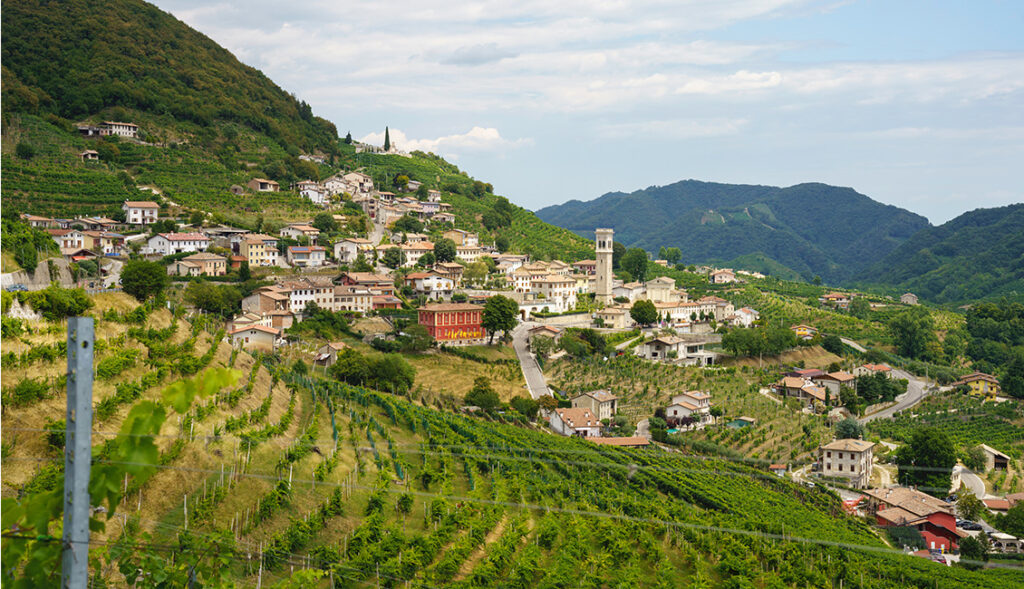
Valdobbiadene is the production area of Prosecco. It is a charming corner of the province of Treviso , in the Veneto region, north-east of Italy. This area is celebrated for its natural beauty and production of the renowned Prosecco sparkling wine.
The hills of Valdobbiadene are a picturesque landscape of vineyards that climb steep slopes and sunny exposures. The predominantly hilly terrain is characterized by calcareous and clayey soils , offering an ideal environment for the cultivation of Glera grapes, the main variety used for the production of Prosecco . These geographical conditions contribute to the creation of fruity, fresh and lively wines.
The region's climate is temperate, with cold winters and mild summers , providing excellent temperature variability between day and night. This temperature range helps preserve the acidity of the grapes, maintaining a vibrant freshness in the final sparkling wines.
The hills of Valdobbiadene have been recognized as a World Heritage Site by UNESCO , a testament to their cultural and historical importance. The care for the vineyards is often managed by generations of winegrowing families who maintain traditional and environmentally friendly cultivation methods.
Chianti
The production area of Chianti wine is located mainly in the Tuscany region , in the heart of Italy. This prestigious wine area is characterized by a breathtaking hilly landscape, dotted with neatly arranged vineyards, olive groves and medieval villages that lend a rustic and authentic charm to the region.
The Chianti vineyards extend over rolling hills, with an altitude ranging from approximately 150 to 500 meters above sea level. This varied altitude helps create unique climatic conditions, influenced by a combination of maritime and continental factors. The soils, often calcareous and rich in clay, provide an ideal soil for the cultivation of Sangiovese grapes, the main variety used to produce Chianti wine.
The climate of the area is characterized by hot and dry summers , which favor the optimal ripening of the grapes, while the winters are cool and moderate. These climatic conditions contribute to giving Chianti its characteristic freshness, balanced acidity and aromatic complexity.
The Chianti denomination is divided into different sub-areas, each with its own specific characteristics. Among the best known are that of Chianti Classico, which represents the historical nucleus of production and extends between the cities of Florence and Siena, and that of Chianti DOC . The strict production rules and the predominant use of the Sangiovese variety give these wines a distinctive personality, with fruity, floral and spicy notes.
No data found